“Work That Matters” is a series in which ECS experts discuss their roles and responsibilities and the larger impact they have in the workplace, community, and world. In this installment, we interview Austin Amaya, PhD, director of AI and Analytics at ECS. For professionals exploring AI careers in defense and national security, or roles related to enterprise AI, Austin’s journey reflects how advanced technical expertise can translate into real-world, mission-focused impact.
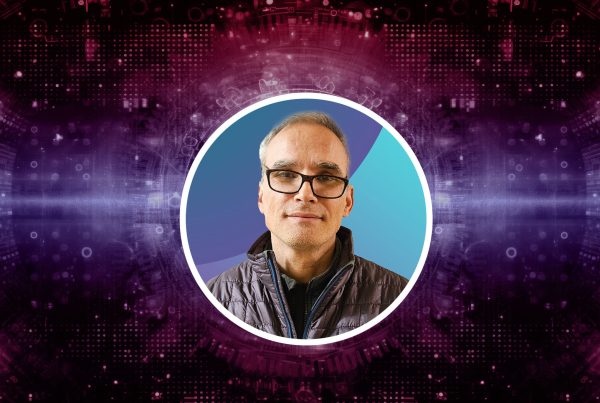
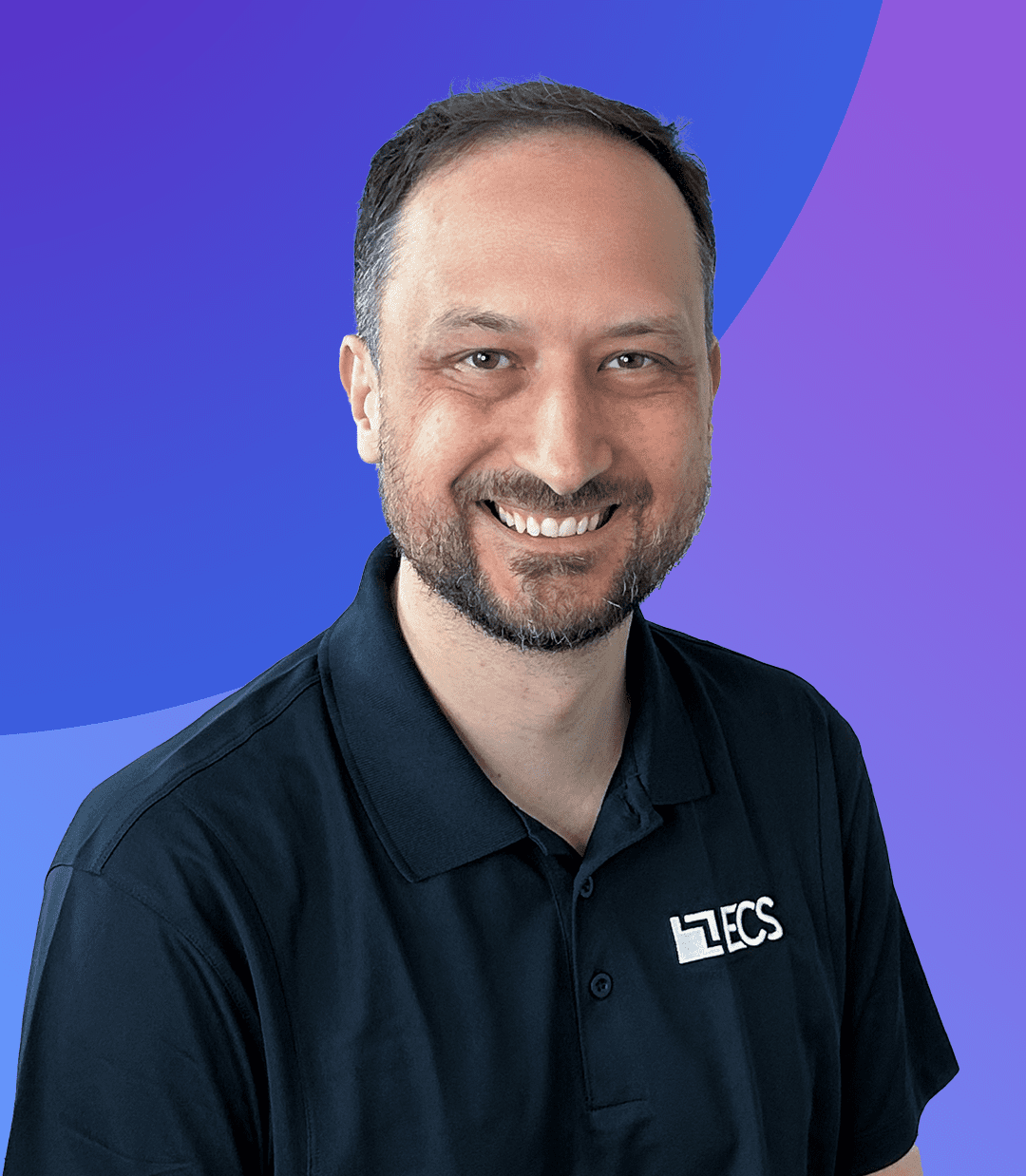
Austin Amaya, PhD, Director of AI and Analytics
Q: Tell us a little about your background. How has it impacted your career in enterprise AI?
A: I describe myself as a “recovering academic” who’s had a long trajectory (multiple master’s degrees, a highly theoretical PhD in mathematics) to reach practical, hands-on roles.
During graduate school, I spent years teaching math and physics. I had thousands of students over that time, and teaching became one of the most formative experiences of my career. It helped me understand not only how to connect with people, but to help them understand complex ideas and technologies. Those skills would later serve as the basis for my career at ECS and shape my path into applied AI leadership roles.
Q: What led to you moving on from academia and how did you end up at ECS?
A: After finishing my PhD, I realized I wanted to focus more on applied problem solving. While academia is rewarding, it involves very little of this hands-on work. I wanted to build things and see them make a real, tangible impact, which led me to pursue a few different mission-driven AI roles in the defense space.
I spent nearly a decade supporting a U.S. Navy autonomous system designed to hunt undersea mines. I started as a lead algorithm developer and eventually became a team lead. The work involved AI, sonar, and advanced signal processing in one of the most complex environments imaginable, the ocean.
Later, I supported AI testing and evaluation efforts for a private company on the National Geospatial-Intelligence Agency’s (NGA) Maven Program, an endeavor devoted to empowering U.S. warfighters. The Maven program led to my eventual transition to my current role at ECS and further deepened my experience in operational AI supporting national security missions.
Q: What does your role at ECS look like?
A: As the Director of AI and Analytics at ECS, I’m tasked with helping people understand, adopt, and responsibly operationalize emerging AI technologies across the AI development lifecycle.
Rather than being embedded on one delivery team, I look at how AI and other emerging technologies can benefit the entire organization. This includes ensuring that ECS always brings the best of our organization to every AI engagement. It also entails connecting expertise across business units, advising teams on AI development lifecycle challenges, and helping shape how we approach new opportunities.
Sometimes I support teams standing up testing and evaluation pipelines. Other times, I’m helping think through AI acquisition strategies or broader implementation questions. A big part of my role is being a bridge: between technologists and executives, between innovation and execution, and between what’s possible and what’s practical in mission-focused AI programs.
Q: What do you appreciate the most about working at ECS?
A: Our hands-on experience. Especially in defense and intelligence environments.
There are very few organizations that have delivered the full AI development lifecycle at scale, in production, for as long as ECS has. There’s a significant difference between experimenting with AI and deploying it in operational settings where performance, compliance, and mission impact truly matter.
Through years of hands-on engagement, ECS has developed practical insight into iteration, testing, validation, and deployment. Those lessons are hard-earned, and they position us well as agencies accelerate AI adoption.
Q: What skill has been most important in your career?
A: To go full circle: teaching.
Not just in a classroom sense, but the ability to explain complex ideas clearly and build a conversational bridge. My role requires me to speak with deeply technical experts one moment and senior executives the next. I have to gauge what’s landing, adjust when it’s not, and meet people where they are.
AI is a powerful tool, but only if people understand it well enough to use it strategically and responsibly. If I can help build that bridge, then I’m doing my job correctly.